


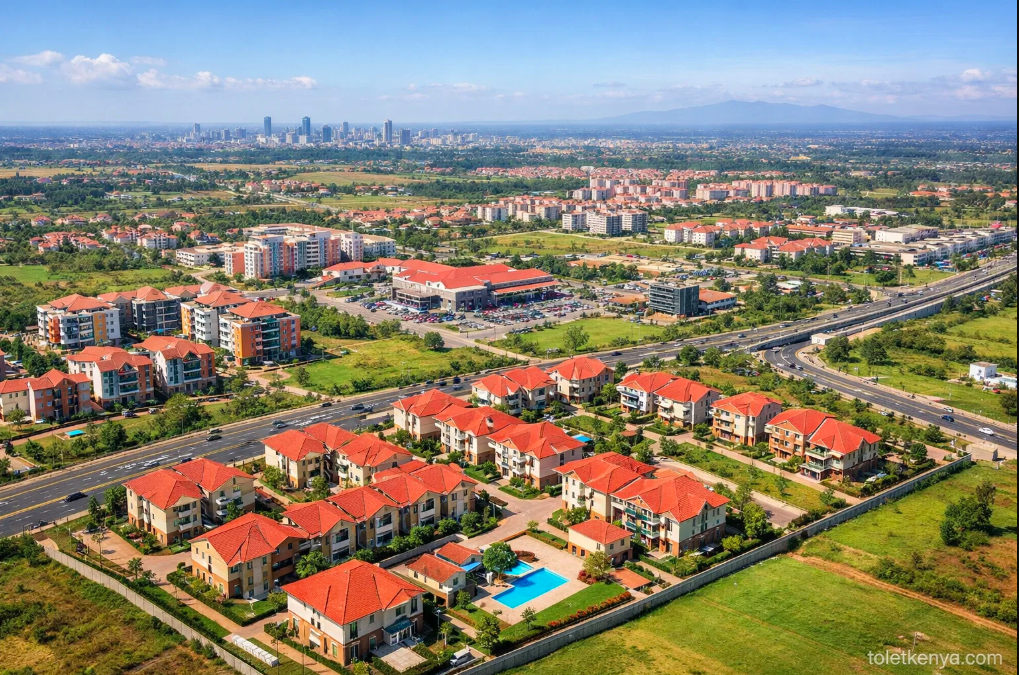
For years, property investment in Nairobi focused on the city’s core neighborhoods. But in 2026, the strongest momentum is increasingly shifting beyond the capital’s boundaries. Satellite towns surrounding the city are rapidly emerging as some of the most attractive real estate destinations in Kenya, drawing buyers priced out of the urban center and investors seeking higher growth potential.
This transformation reflects deeper changes in infrastructure, affordability, and urban expansion patterns that are redefining how and where Kenyans live and invest.
Infrastructure Is Redrawing the Property Map
Improved transport links are one of the biggest drivers of growth in Nairobi’s satellite towns. Expanded highways, bypass roads, and commuter transport options are cutting travel times and making previously distant areas more practical for daily commuting.
As connectivity improves, property values tend to follow. Investors often enter these markets early, anticipating future demand once infrastructure projects are completed. This pattern has already played out in several suburban zones, where land prices have risen steadily after road upgrades or commercial development announcements.
The ripple effect is clear: once access improves, residential projects quickly follow.
Affordability Is Pushing Buyers Outward
Rising land and housing costs in Nairobi’s central areas are forcing many buyers to look beyond the city for options within reach. Satellite towns offer significantly lower entry prices, larger plots, and newer housing developments tailored to middle-income buyers.
For first-time homeowners, these areas provide a realistic path to ownership that is increasingly difficult to achieve inside the capital. Developers are responding with gated communities, apartment complexes, and mixed-use projects designed to meet this growing demand.
The affordability factor also attracts rental investors, as lower purchase costs combined with steady tenant demand can produce more attractive yields than in saturated urban neighborhoods.
Urban Growth Is No Longer City-Bound
Kenya’s urbanization is no longer confined to Nairobi itself. Population growth, business decentralization, and the expansion of industrial parks are encouraging people to live closer to emerging employment zones rather than commute long distances into the city.
This shift is transforming satellite towns from dormitory suburbs into self-sustaining urban hubs with schools, retail centers, and healthcare facilities. As these amenities expand, the appeal of the surrounding property market strengthens further.
For investors, this trend signals long-term potential. Properties in well-planned satellite towns often appreciate as infrastructure and services mature, offering both rental income and capital growth.
Also Read: Is Kenya’s Housing Surge Ending? New Data Reveals Market Shift
Opportunity With a Need for Careful Selection
Despite the optimism, not every satellite town will perform equally. Investors must evaluate transport access, zoning plans, and infrastructure timelines carefully. Some areas may take longer to develop than expected, tying up capital for extended periods.
Still, the broader direction of Kenya’s property market is unmistakable. Growth is spreading outward, and satellite towns are becoming central to the country’s housing future.
In short, Nairobi’s expansion is no longer just vertical — it is geographic. For buyers and investors willing to look beyond the city center, the next wave of opportunity may already be taking shape just outside it.